
For many small and growing sellers, selling on a large marketplace looks like the obvious route to customers. The audience is already there. But the true cost of reaching that audience is often much higher than it first appears, and it keeps rising.
This article looks at where the money goes, why it hurts smaller sellers most, and how a buyer-led model changes the equation.
The costs add up in layers
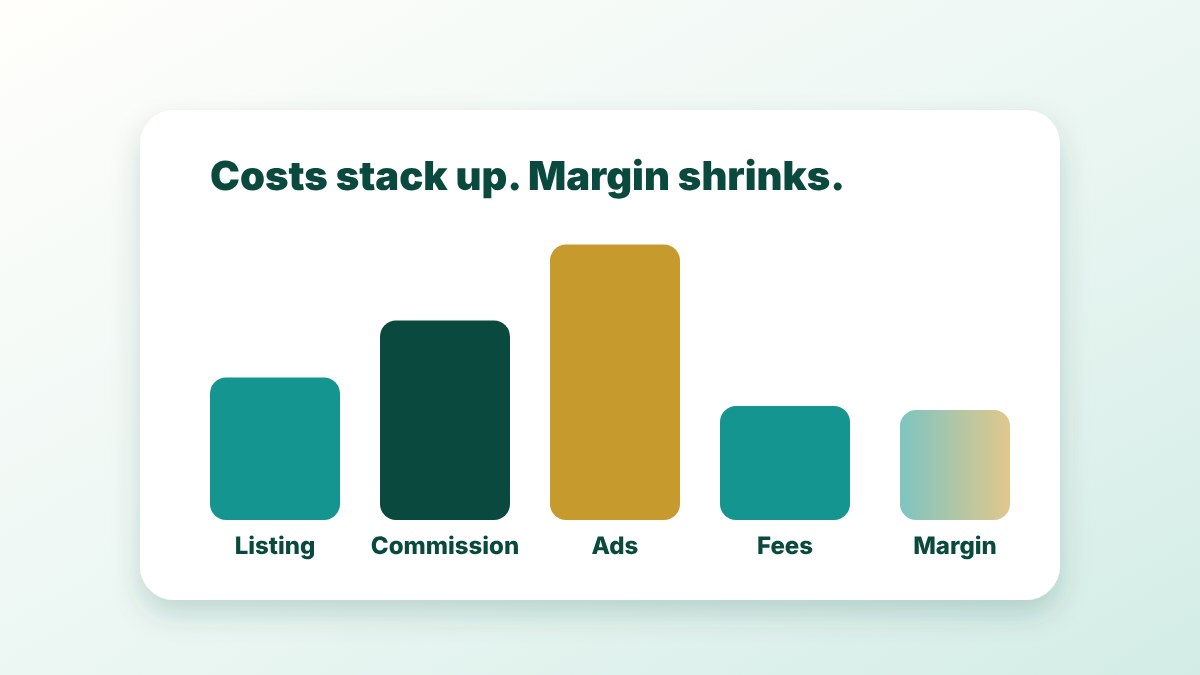
On most large marketplaces a seller faces several separate costs, and they stack:
- **Listing or subscription fees**, paid whether or not the product sells.
- **Commission on each sale**, taken from the revenue.
- **Payment and processing charges**, which come on top.
- **Advertising spend**, because visibility is rarely free once many sellers offer the same product.
- **Fulfilment, returns and promotional costs**, which vary by programme.
Individually each charge can seem reasonable. Together they can leave a thin margin, particularly on competitively priced goods such as electronics and household products.
Visibility has become a budget line
The deeper issue is not a single fee. It is that visibility itself is for sale. When many sellers list near-identical products, the ones who appear first are often the ones who pay for placement. That turns a sale into an auction for attention, and the sellers with the biggest budgets tend to win the most prominent spots.
For a small seller the choice can feel unfair: spend hundreds of pounds on promotion with no guarantee of a sale, or stay invisible. Either way, money is spent before a single buyer has shown real interest in the product.
Why smaller sellers feel it most
Large sellers can spread advertising costs across huge volumes and negotiate better terms. Smaller sellers cannot. They are forced to compete on promotion rather than on what they are actually good at, such as better service, honest stock levels, faster delivery or a stronger warranty.
That is a poor outcome for buyers too, because the seller who is best for the buyer is not always the seller who can pay the most to be seen.
The alternative: respond to demand that already exists
A buyer-led model flips the sequence. Instead of publishing a listing and hoping to be found, sellers see organised demand first: a group of verified buyers in a region who have asked for a specific product.
On Peddlo:
- Sellers declare their regions and categories, so they see only demand that fits.
- Approved sellers are invited to respond when enough buyers have joined a request.
- The seller sends a clear offer with price, delivery, warranty, stock and terms.
- Buyers compare offers on overall value and agree the final deal with the seller they choose.
You can read the seller journey on the sellers page and the step-by-step process on how it works.
What that means for your costs
- **No advertising budget to be seen.** Offers are compared on overall value, not on who paid for placement.
- **No listing catalogue to maintain.** You respond to demand rather than publishing and renewing listings.
- **You respond where it makes sense.** You choose requests that match your stock, region and terms.
Peddlo is transparent that it is not free to run. There are platform access fees, which are separate from buyer product payments and are set out in the platform fee policy. A verification fee applies before formal offers, and further fees apply only where there is real, organised buyer demand and a selected-offer opportunity. During the launch offer, approved sellers can join without the standard onboarding fee until 2 January 2027.
What it does not promise
Fairness means being straight about this too:
- Buyer interest does not guarantee a completed sale. Buyers decide for themselves.
- Peddlo is not the seller and does not process buyer product checkout. The sale, delivery, returns and warranty are agreed directly between you and your buyer.
- Sellers are approved before they can respond, and standards apply.
Who this suits
A buyer-led route suits sellers who:
- can fulfil the products and regions they offer;
- would rather compete on overall value than on advertising;
- prefer to respond to proven demand than to guess.
If that sounds like you, read how approved sellers work on the sellers page, and see how the economics compare with our article on why small sellers struggle to reach buyers without an advertising war.
This article reflects Peddlo's perspective and general market observations. It is not legal or financial advice, and it does not describe any named company.
